Prof. dr. Roberto Biloslavo

Better questions.
Wiser decisions.

Exploring how organisations decide, adapt and create lasting value — through strategy, wisdom and sustainability.

Research & ideasHigher educationPractice & learning
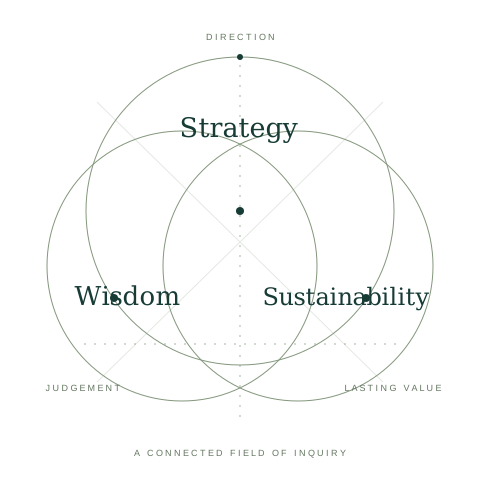
Strategy, wisdom and sustainability shown as connected fields of inquiry
Ideas meet at the intersections
University leadershipVice-President · EMUNI University

Full professor of management

Research leadershipInstitute for Behavioural Economics

Acting Head · ZRS Koper

A continuing questionHow can organisations decide more wisely?

People, purpose and long-term consequences

Scholarship with a wider lens

Organisations are more
than their plans.

They are relationships, habits, competing priorities and ideas about what matters.

Roberto Biloslavo is a full professor of management and Vice-President of EMUNI University. His research connects strategic management, organisational knowledge, leadership, wisdom and sustainable business models. Recent work also examines AI and organisational change, and decision-making in sport.

His academic leadership includes service as Vice-Rector for Academic Affairs at the University of Primorska from 2008 to 2011. At ZRS Koper, his public biography identifies him as Acting Head of the Institute for Behavioural Economics.

PhD · University of Ljubljana, 2003Full professor of management since 2011Institutional biography ↗
1992Mechanical engineering
University of Ljubljana
1997Master's in management and organisation
University of Ljubljana
2003Doctorate in business information sciences
University of Ljubljana
2011Elected full professor
Management
Selected research

Ideas with consequences.

Browse the research library
Sustainable business models2018

An eco-critical perspective on business models: The value triangle as an approach to closing the sustainability gap

The Value Triangle broadens business model discussion beyond the customer. An eco-critical reading of established frameworks leads to a proposal that connects public, partner and customer value, explicitly bringing society, nature and future generations into the picture.

Eco-critical analysis of 20 business model frameworks, followed by an illustrative company case; university abstract reviewed.

Journal of Cleaner ProductionView record
AI and organisational change2026

The role of artificial intelligence in change management: opportunities and challenges

AI can assist organisational change while also unsettling roles, routines and expectations. This review connects technological possibilities with cultural friction and ethical governance, developing propositions for understanding change as an ongoing process rather than a single implementation event.

Narrative literature review of 47 sources, as described in the GCU university abstract.

Accepted / in pressView record
Judgment and decision-making2025

Conceptual framework of coaches’ decision-making in conventional sports

A coaching framework distinguishes strategic, tactical and operational decisions, connecting different demands with cognitive processes and leadership. Developed with conventional sports and gymnastics in view, it offers a structure for discussing how the decision situation shapes the expertise required.

Conceptual model paper; selected framework and conclusion passages checked on the publisher's open article.

Frontiers in PsychologyView record
A recent book · 2026

What changes when an organisation changes?

A multidisciplinary exploration of identity, strategic paradoxes and organisational transformation.

Co-authored with Beniamino Mirisola, Carlo Bagnoli and David Edgar, Business Transformation brings Jungian analytical psychology and alchemical symbolism into a discussion of enterprise development.

From the journal

Room to think.

All editorial notes

Prepared editorial explainers for review; these notes are not presented as articles authored or approved by Roberto Biloslavo.

From an idea to an inquiry

A useful conversation
begins with a clear question.

Explore possible research connections in decision-making, sustainable business models, higher education and organisational change.